

Classified by the inner ring locking method (three major series)
UC series: for agricultural machinery, fans, conveying equipment, food machinery, etc., in scenarios with medium-low speed and stable load
UEL/UE series: commonly used in textile machinery, packaging machinery, etc., for medium-speed equipment that requires certain adjustment capabilities.
UK series: suitable for equipment with higher rotational speed, heavier load, or those that need frequent disassembly and assembly, such as some construction machinery and mining equipment. Classified by the shape of the bearing housing (common housing types) The bearing housing is the “interface” for installation, and different shapes determine the installation method and occupied space. The common letter meanings in the housing type codes are: P (vertical), F (square), FL (rhombic), T (slider), C (circular), etc.
Cast iron material is used for overall casting, with high strength and rigidity, and is the most widely used type.
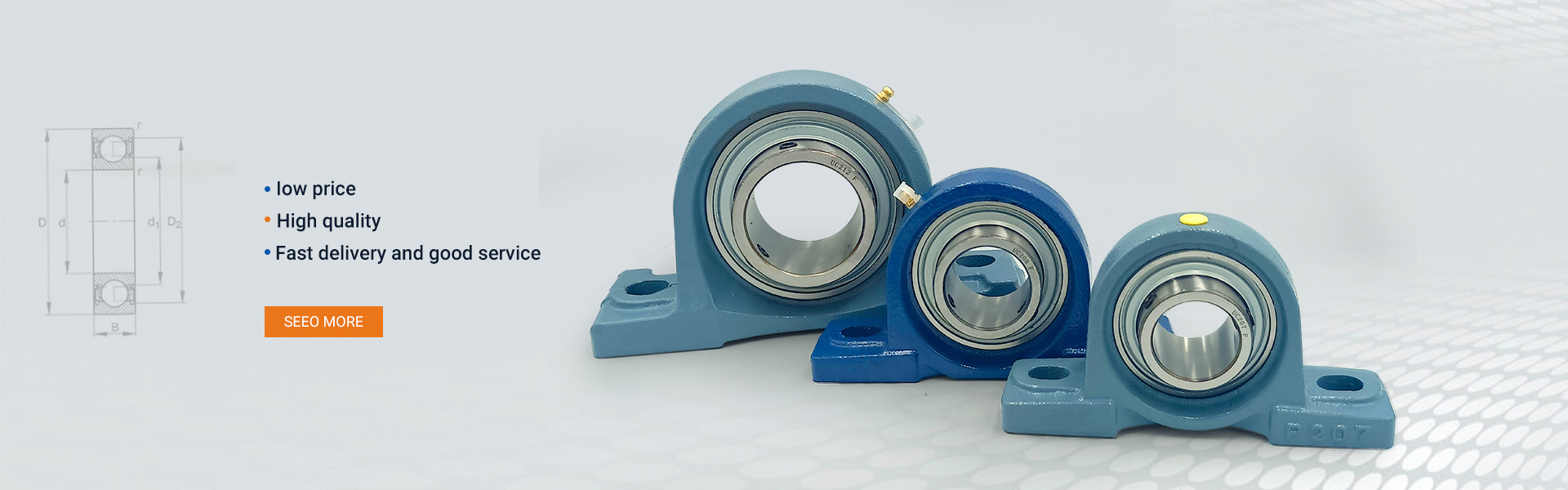
Vertical housing: the most commonly used type. Codes such as UCP, UCFP, are suitable for regular equipment bases.
Square housing: code UCF, with a square installation surface, usually has 4 installation holes, and has a compact structure.
Rhombic housing: code UCFL, with a rhombic installation surface, suitable for use in scenarios with limited space or where side fixation is required.
Slider housing: code UCT, with the bearing housing that can slide in the slot, suitable for scenarios where the tension of belts and chains needs to be adjusted.
Circular housing: code UCC, with a circular shape, often used on pipes and cylindrical equipment.
High center vertical housing (UCPH): with a center height higher than the ordinary vertical housing, suitable for special installation heights.
Suspension/Hanging housing (UCHA/UCB): for suspension installation, suitable for top-mounted transmission or special mechanical structures.
Stressed housing: such as PF, PFL, PFT, made by stamping steel plates, with lower cost and lighter weight, often used for non-critical equipment with low load.
Note: One bearing unit is usually named by “bearing code + housing type code”. For example, UCP205, represents an internal UC205 bearing and is installed in a vertical (P) housing.
To select the most suitable bearing, it is recommended to follow the following steps:
Clarify the working conditions: determine the load size (radial/axial), speed range, working temperature, and environment (such as dust, humidity, corrosiveness).
Determine the locking method: based on whether the rotation direction of the shaft is constant, the speed level, and the frequency of disassembly, choose from the UC, UEL, UK series.
Select the housing form: based on the installation space, position, and connection method provided by the equipment, determine the appropriate housing type.
Verify the installation dimensions: focus on checking key dimensions such as shaft diameter, center height, and installation hole spacing to ensure compatibility with the existing design.
Consider maintenance convenience: prioritize selecting bearings with oil ports and good sealing performance to simplify later maintenance and extend service life.
Post time: Apr-08-2026


