


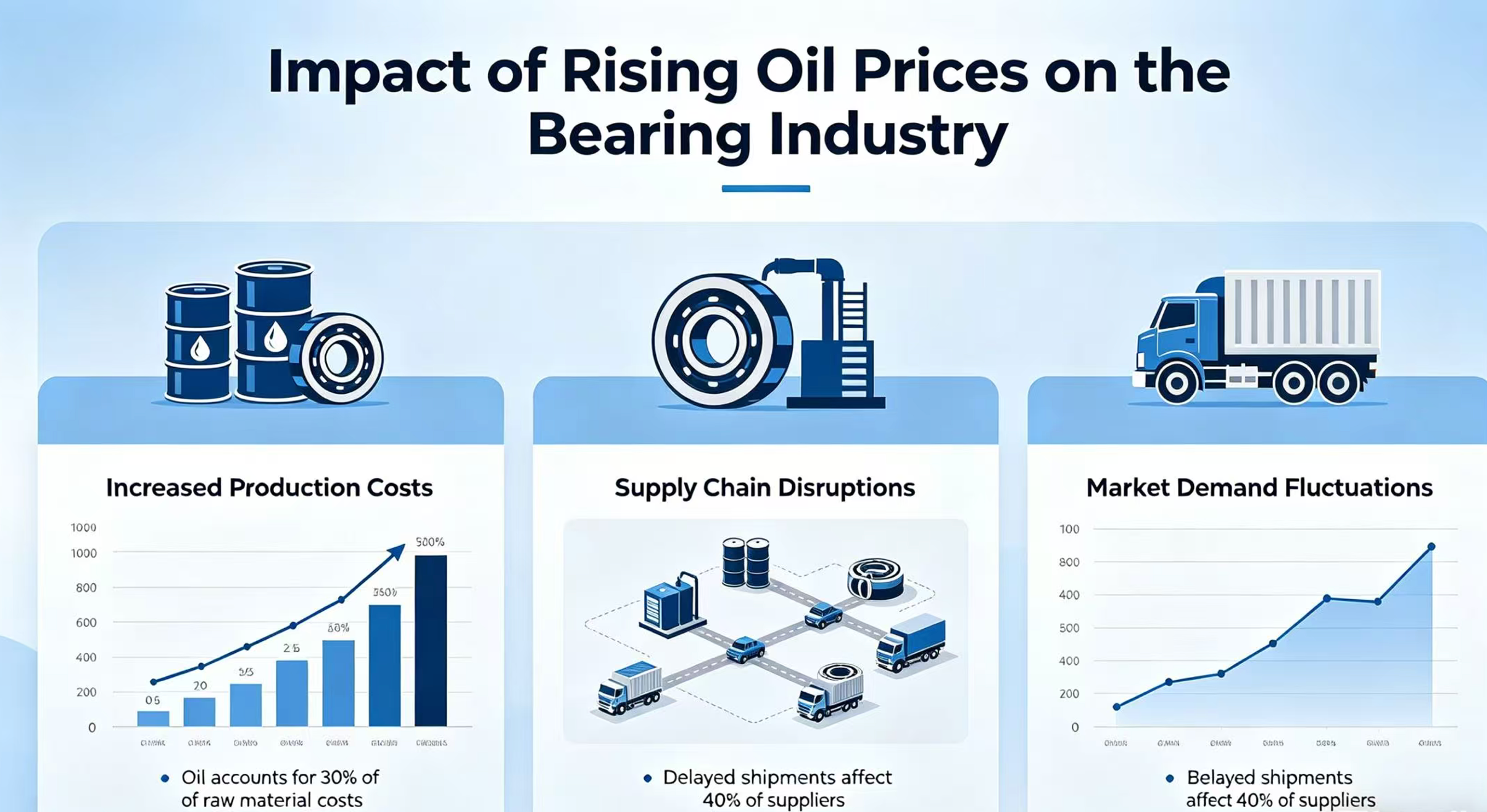
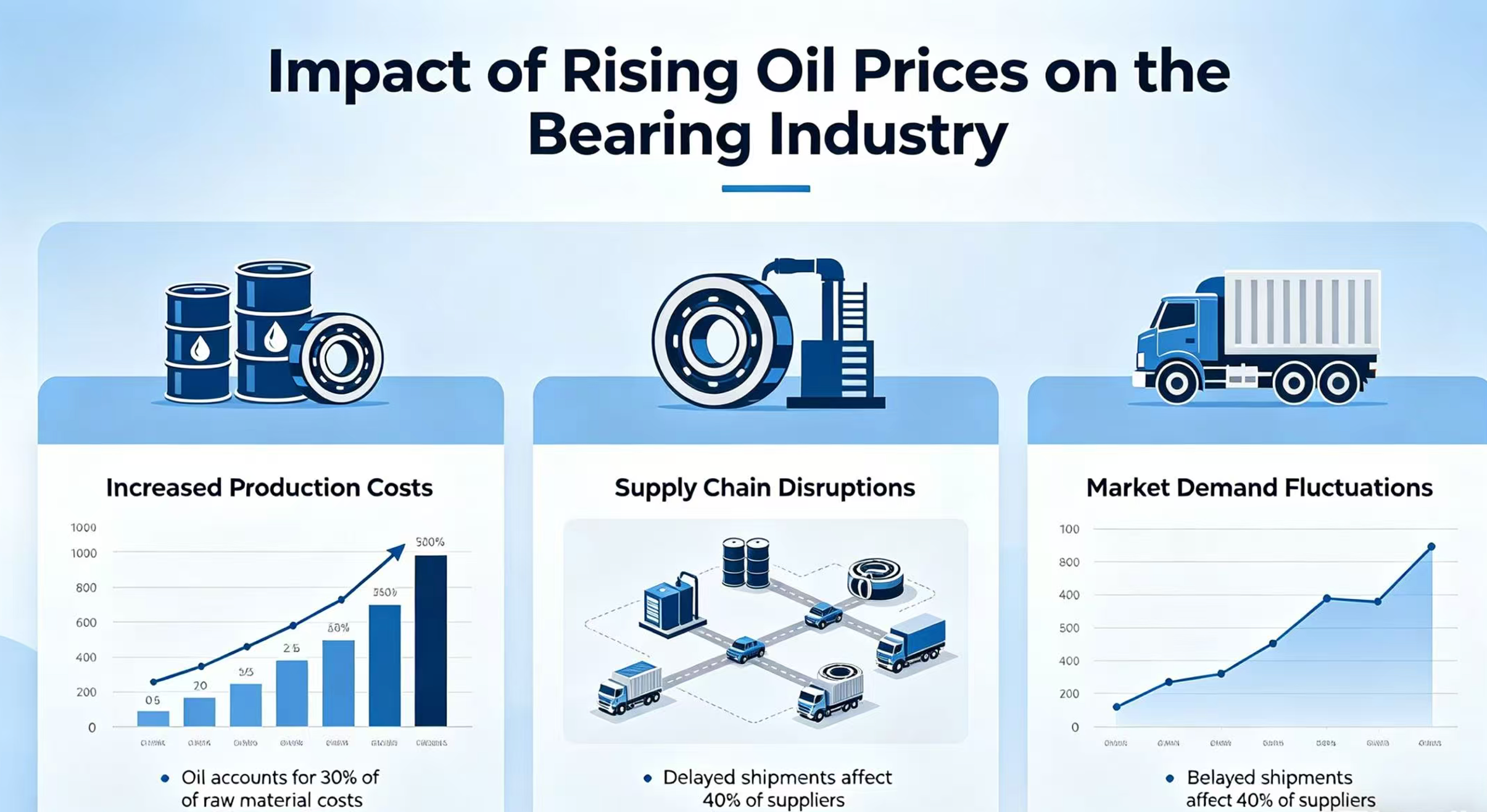
 The sharp increase in oil prices caused by the conflict in Iran (reaching over $100 per barrel in March 2026) has had a triple impact on the bearing industry (especially for our business of exporting external pillow block bearing): cost increase, demand differentiation, and pressure on logistics. It is bearish in the short term and has structural opportunities in the medium to long term.
1. Cost side: Direct increase, squeezing profits
1. Energy and chemical costs have increased; power/gas consumption in bearing production (forging, heat treatment, grinding) is high; rising oil prices → electricity and gas prices also rise simultaneously, resulting in a 5% to 12% increase in production energy costs.
Lubricants, seals, and plastic spacers are directly made from petroleum derivatives: base oil, rubber, and nylon prices have risen, and the cost of sealing and lubrication components has increased by 10% to 20%.
2. Indirect increase in raw materials (steel)
The smelting of bearing steel is energy-intensive; rising oil prices → increased costs for alloys, chromium, molybdenum, and nickel → higher costs for bearing steel and special steel.
Raw materials account for 60% or more of the cost of bearings; for every 10% increase in steel prices, the cost of bearings rises by 5% to 8%.
3. Increase in logistics costs (major affected area in foreign trade)
Rapid surge in fuel surcharges for shipping and air transportation: Freight on the Middle East route has increased by 30% to 80%, and the delivery cycle has lengthened.
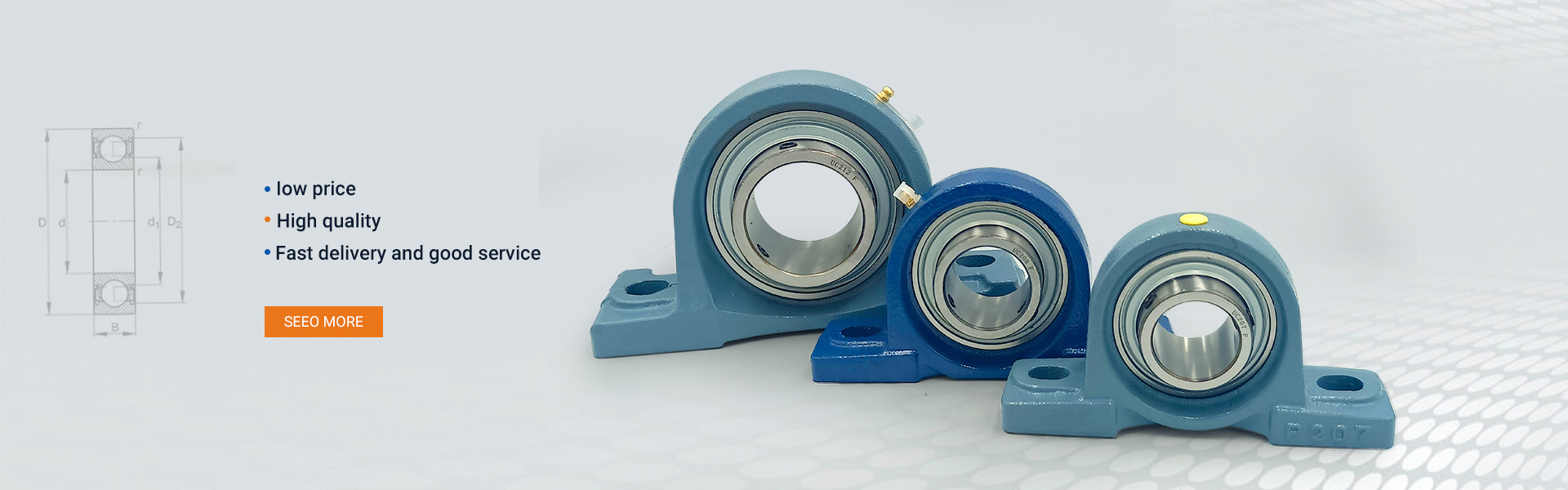
We export spherical bearings with seats: Increased logistics costs for cross-border trade, unstable delivery cycle.
II. Demand Side: Clearly Diversified (Positive/Negative)
Negative: Weak downstream demand
General machinery, textiles, light industry, ordinary agricultural machinery: Cost-sensitive, oil prices →开工 rate ↓, orders shrink.
Automobiles, low-end construction machinery: High oil prices suppress investment → Bearing support for bearing components slows down.
Middle East/Iran market: Turmoil in the situation → Order freezes, collection difficulties, delivery obstacles.
Positive: High-growth sectors
Petroleum equipment (drilling/production/pipeline transportation): High oil prices → Capital expenditure ↑, demand for petroleum machinery bearings, mud pump bearings, pumping unit bearings increases significantly.
Mining/metallurgy/heavy-duty transportation: Oil prices → Mineral prices ↑ → Demand for mining machinery, belt machine bearings (your strong point) ↑.
Wind power/new energy: High oil prices force the acceleration of new energy → Wind bearing, new energy equipment bearings orders ↑.
Military/shipbuilding: Geopolitical tensions → Military bearings, marine bearings demand steadily increases.
III. Specific Impact on Self-Braceball Bearings (Your Main Product)
Cost: Steel + sealing + lubrication + energy + logistics all rise, factory price forced to increase by 5% to 12%.
Demand
Strong demand: Mining belt machines, petroleum equipment, heavy-duty agricultural machinery, wind turbines (your advantageous application).
Weak demand: Food machinery, ordinary textiles, light industry transportation (cost-sensitive). Foreign Trade
Europe/North America: Inflationary pressure → Negotiation becomes difficult, payment terms are prolonged.
Middle East: Order suspension, logistics disruption, collection risks.
ASEAN/Russia/Central Asia: Relatively safe, can transfer orders. Competition
Small and medium-sized factories: Unable to bear costs → reduce production/exit.
Large factories: Have the ability to pass on costs → increase market share.
IV. Strategies that 2026 foreign trade bearing factory can adopt
1. Cost control
Form long-term contracts and lock prices with steel mills/chemical suppliers.
Process energy saving: reduce power consumption in heat treatment/milling, use low-viscosity lubricants.
Optimize packaging/consolidation: reduce unit logistics costs.
2. Products & Pricing
Prioritize supply to high-margin sectors such as mines/petroleum/fans/heavy-duty agricultural machinery.
Gradually adjust prices in batches (5% – 8%), with cost explanations attached.
Introduce economical seals/simplified models to meet the demands of price-sensitive customers.
3. Market & Orders
Contraction of high-risk markets in the Middle East, shifting orders to ASEAN, Russia, Central Asia, and Latin America.
Offer moderate discounts to long-term customers to lock orders and stabilize cash flow.
Expand oil equipment, mining machinery end customers.
4. Risk Hedging
Order price linkage/foreign exchange terms.
Multiple shipping routes as alternatives, booking in advance.
Slightly increase the inventory of commonly used models to avoid supply disruptions.
V. Summary (one sentence)
Short-term cost increase, profit pressure, risks in the Middle East; medium and long-term favorable for petroleum/mining/heavy-duty bearings (your strength in hubless spherical surfaces), accelerating industry consolidation, and stronger players increasing their market share.
Post time: Apr-10-2026


